A custom sport court builder does more than install a playing surface. The right court becomes part of the way your family gathers: the place for a quick game before dinner, a weekend tournament with friends, or an active afternoon when the pool party needs another destination. In a thoughtfully designed backyard, it should feel as intentional as the patio, outdoor kitchen, fire feature, and landscape surrounding it.
For homeowners investing in a complete exterior transformation, the goal is not simply to fit a basketball hoop or pickleball lines into an open corner of the yard. The goal is to create a recreation space that performs well, looks refined, and belongs to the property.
Start With the Way Your Family Will Play
The most beautiful court is still the wrong court if it does not support the games your household actually enjoys. A family with young basketball players may prioritize a regulation-style half court, adjustable hoops, and room for spectators. Homeowners who entertain often may prefer a pickleball court with seating nearby, landscape screening, and lighting that extends play into the evening.
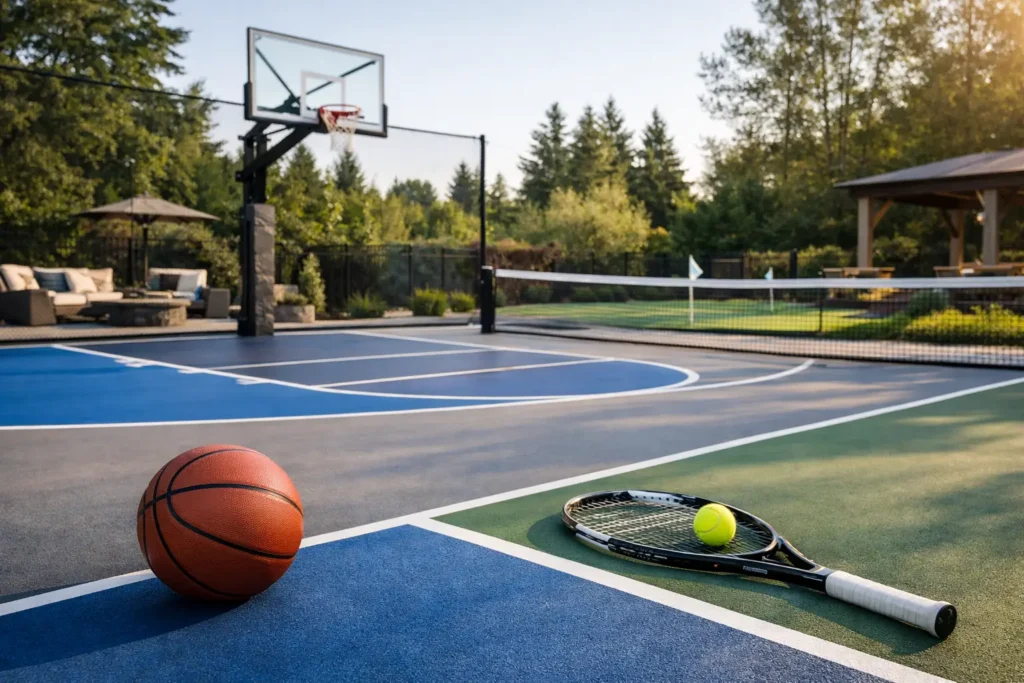
Multi-sport courts are often an excellent choice when several ages and interests share the backyard. With the right layout and line configuration, one space can support basketball, pickleball, volleyball, tennis practice, and casual games. The trade-off is that a multi-use court may not provide the full dimensions or dedicated experience of a single-sport court. That is not a compromise when the design reflects how the family lives. It is a smart use of space.
Before design begins, consider who will use the court, how often they will play, and whether it is meant for serious training, relaxed recreation, or both. Those answers shape everything from dimensions and surfacing to fencing, lighting, and access.
A Custom Sport Court Builder Plans Beyond the Lines
Court dimensions matter, but the surrounding zone matters just as much. Players need run-off space, guests need comfortable paths around the court, and the backyard needs enough breathing room for the feature to feel integrated rather than inserted. A court that is technically large enough can still feel cramped if gates, walls, planting beds, or furniture interrupt circulation.
Site planning also accounts for grade, drainage, sun exposure, existing structures, views, and privacy. In Sunbelt climates, heat and glare deserve particular attention. Court orientation can affect how often players are looking into the afternoon sun. Nearby shade structures, trees, and architectural elements can make the setting more comfortable, though they must be placed carefully to avoid interfering with play or creating maintenance concerns.
A custom sport court builder should evaluate the whole property before recommending a location. Sometimes the obvious open lawn is the right answer. Other times, moving the court closer to a retaining wall, creating a level terrace, or connecting it to an existing patio produces a much stronger overall plan.
Drainage Is a Design Detail, Not an Afterthought
Sport courts need a stable, properly prepared base and a plan for moving water away from the surface. Standing water can interrupt play, contribute to surface wear, and create avoidable headaches around adjacent hardscapes and landscaping.
Proper grading, base preparation, edge treatment, and drainage work together. The details depend on the site, soil conditions, court system, and surrounding construction. A level playing surface does not mean water has nowhere to go. It means the court has been engineered with subtle, intentional drainage in mind.
Choose a Surface That Matches Performance and Style
The surface underfoot influences traction, ball response, comfort, maintenance, and the visual character of the backyard. Acrylic-coated concrete is a familiar option for basketball and tennis-style play, offering a clean, durable finish with customizable colors and game lines. Modular athletic tile systems can provide additional cushioning and drainage, and they often bring a more forgiving feel to active play.
Neither option is automatically better. A hard-coated surface can feel crisp and classic, while modular tile may be especially appealing for families who want lower impact underfoot and all-weather playability. Budget, sport selection, sub-base requirements, climate exposure, and desired appearance all deserve consideration.
Color should be chosen as part of the broader landscape palette. Bold team-inspired combinations can be fun, particularly for a dedicated basketball court. For a more understated resort-style setting, charcoal, slate blue, warm gray, soft green, or coordinated neutral borders may complement stone, pavers, pool finishes, and outdoor furnishings more naturally.
The court can still have personality without competing with the rest of the backyard. Custom logos, monograms, contrast borders, and carefully selected line colors offer opportunities to make the space personal.
Build the Court Into a Complete Backyard Experience
A court becomes more inviting when it has a place to pause. This might be a small paver terrace with benches, a shaded pavilion nearby, or lounge seating positioned for parents and guests to watch without standing on the sidelines. If the court sits near an outdoor kitchen or pool, circulation should allow people to move between spaces without crossing active play areas.
Landscape planting plays an important role as well. Evergreen screening can provide privacy and soften fencing. Ornamental grasses and layered shrubs can create a polished transition from hardscape to garden. Trees may provide welcome shade, but they should be selected and positioned with a realistic understanding of root systems, leaf drop, and clearance from the playing area.
Fencing is another decision where function and aesthetics must work together. It protects neighboring windows, helps keep balls contained, and defines the court zone. Black-coated fencing often recedes visually into the landscape, while a more architectural screen wall can create privacy and reinforce the style of the home. The right solution depends on ball speed, property boundaries, local requirements, and the desired level of enclosure.
Lighting Extends the Value of the Space
Evening play is one of the strongest reasons to include court lighting, especially in warm climates where families spend more time outdoors after sunset. Well-planned fixtures illuminate the court evenly while limiting spill light toward the home and neighboring properties.
Lighting should also feel considered when the court is not in use. Fixtures, poles, and controls are visible parts of the design. Selecting equipment that suits the scale of the property and coordinating it with pathway, landscape, and patio lighting preserves the elevated look of the entire environment.
Understand What Drives the Investment
A custom court is not a one-price feature because the site and scope can vary dramatically. Size, earthwork, retaining walls, drainage, surfacing, fencing, lighting, equipment, access for construction, and surrounding landscape all affect the final investment.
A relatively level backyard with easy access may require less site preparation than a sloped lot that needs excavation, structural retaining, and new drainage infrastructure. Likewise, a simple half court will have a different cost profile than a fully lit, fenced, multi-sport court connected to a pool deck, pavilion, and outdoor entertaining area.
The most useful budget conversation begins with priorities. Decide what cannot be compromised: full-court dimensions, a particular sport, evening lighting, privacy, or an integrated setting. From there, a skilled design-build team can help identify where phased construction makes sense and where reducing scope could undermine long-term performance.
Look for a Design-Build Partner, Not Just an Installer
The best project experience comes from a team that sees the court as one part of a larger outdoor environment. Installation expertise is essential, but so is the ability to coordinate grading, hardscape, landscape, drainage, structures, electrical work, and finish selections under one cohesive vision.
At Beyond Backyard Living, that broader approach allows recreation features to be planned alongside the spaces that make a backyard feel complete. Instead of treating the court as an isolated addition, the design can connect it to the home, frame it with beauty, and make it feel ready for guests from the first day of play.
Ask prospective builders how they evaluate drainage, prepare the base, manage grade changes, coordinate lighting, and account for the surrounding landscape. Review how they handle permits, local rules, property setbacks, and equipment placement. A clear process protects both the investment and the finished experience.
Design for the Backyard You Want to Keep Using
The most successful courts invite activity without taking over the yard. They are easy to reach, comfortable to use, and attractive enough to remain a source of pride between games. Whether the vision is a polished pickleball retreat, a basketball half court for growing athletes, or a multi-sport destination for a busy family, every decision should support the life happening around it.
A court built with care gives a backyard another reason to bring people outside. Plan it as a true part of your dream escape, and it can become one of the spaces your family remembers most.