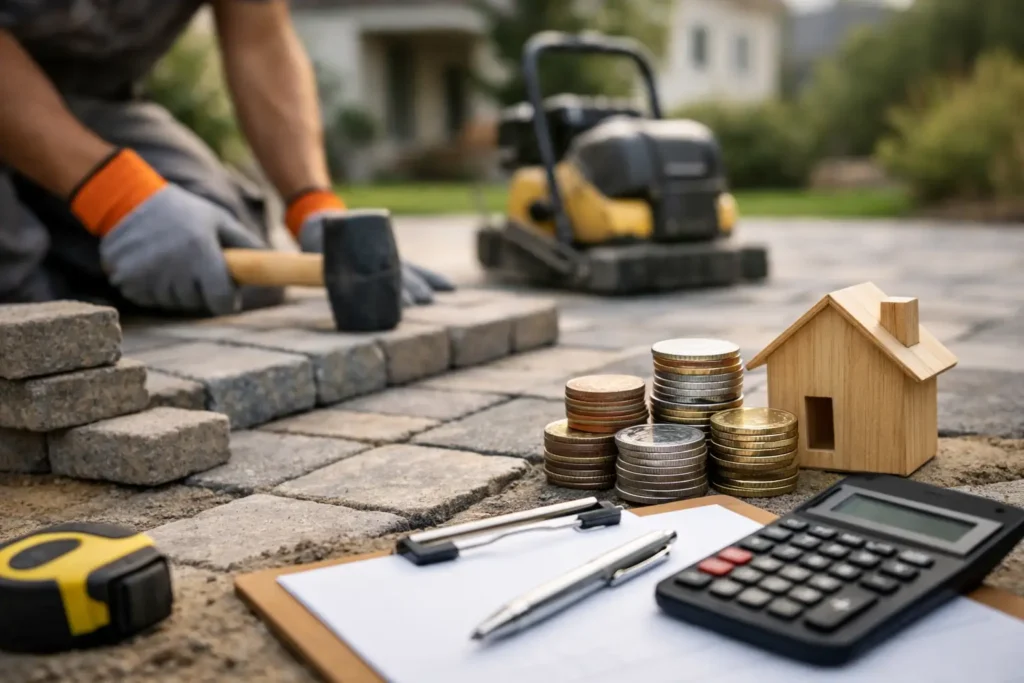
The number most homeowners want first is simple: what will this actually cost? For a premium home, paver driveway installation cost often starts well above basic concrete because you are paying for more than surface area. You are investing in curb appeal, durability, drainage performance, and a finished arrival experience that sets the tone for the entire property.
A paver driveway has presence. It frames the front of the home, elevates landscaping, and creates a more tailored look than a poured slab ever could. But cost can vary widely depending on the size of the driveway, the paver selected, the complexity of the layout, and what has to happen underneath the surface to support it for years to come.
What is the average paver driveway installation cost?
In most markets, paver driveway installation cost falls somewhere between $20 and $40 per square foot for a professionally installed project, with higher-end custom work moving beyond that range. A straightforward driveway using quality concrete pavers on a site with easy access will typically land at the lower to middle end. A larger estate-style entrance with premium materials, borders, lighting coordination, curves, and more demanding prep can climb quickly.
That means a 600-square-foot driveway may start around $12,000, while a 1,000-square-foot driveway can reach $20,000 to $40,000 or more depending on design choices and site conditions. For luxury homes, those higher figures are not unusual because the driveway is rarely treated as a standalone utility surface. It is usually part of a broader front-yard composition.
This is where simple online calculators often miss the mark. They tend to price only the visible layer, when much of the real value is hidden below grade.
What drives paver driveway installation cost
The biggest factor is size, but size alone does not tell the full story. Two driveways with the same square footage can have very different budgets if one is a flat rectangle and the other includes curves, aprons, transitions, steps, or parking extensions.
Site preparation is often the swing factor. If the existing driveway needs demolition and haul-off, if the soil is unstable, or if grading has to be corrected to move water away from the home, the cost rises. In warm-weather and storm-prone regions, drainage planning matters. A beautiful paver surface will only perform as well as the base beneath it.
Material selection also changes the number. Standard concrete pavers are often the most approachable option and still deliver an upscale look when the pattern and color palette are chosen well. Thicker driveway-rated pavers, textured finishes, larger-format units, and specialty shapes all add to material cost. Natural stone can push the budget substantially higher.
Labor is another major component. Precision matters with paver installation. The driveway has to be excavated properly, compacted in lifts, graded accurately, edged securely, and finished so the pattern remains crisp and stable under vehicle traffic. A lower bid can look appealing at first, but shortcuts in excavation depth, base construction, or restraint systems often show up later as settling, shifting, or drainage issues.
Material choices and how they affect price
Concrete pavers remain the most common choice for driveways because they balance design flexibility, performance, and value. They come in a wide range of colors, shapes, and surface textures, which makes it easier to coordinate with the architecture of the home, the roof tone, and nearby hardscape features.
Clay brick pavers offer classic character and warmth, but they may come at a premium depending on the product and availability. Natural stone creates a striking, estate-level finish, yet it usually carries one of the highest installation costs because material pricing and labor complexity both increase.
The pattern matters too. A simple running bond is typically less labor-intensive than a herringbone or multi-size layout with decorative borders. That said, some patterns perform better for vehicular traffic and create a more intentional design statement. For many homeowners, that added investment is worth it because the driveway becomes a defining visual feature rather than an afterthought.
Why the base matters as much as the pavers
A premium driveway is built from the ground up. Excavation depth, aggregate base, compaction, bedding layer, edge restraint, and joint material all affect long-term performance. If the base is undersized or poorly compacted, even expensive pavers can fail.
This is one of the clearest examples of where cost and value are not the same thing. A project with thorough prep may cost more upfront, but it protects the finish, reduces maintenance problems, and helps the driveway hold its lines over time. Especially on larger homes, where the driveway occupies a prominent amount of visual and functional space, structural integrity should never be treated as optional.
Drainage also belongs in this conversation. Water management may involve subtle slope adjustments, collection points, tie-ins to other drainage solutions, or integration with surrounding grading. These details are not flashy, but they are part of what makes a driveway feel polished and professionally resolved.
Design choices that raise or lower the budget
Clean geometry is generally more budget-friendly than highly customized layouts. Straight runs, standard borders, and consistent elevations take less time to install than sweeping curves, inlays, medallions, or multiple transitions into walkways and entry courts.
Still, many homeowners are not looking for the lowest possible number. They want a driveway that complements the home and creates a stronger first impression. In those cases, strategic upgrades often have the best payoff. A contrasting border, a richer paver tone, or a widened apron can dramatically elevate the final look without transforming the project into an entirely different budget tier.
Lighting, columns, landscaping, and adjacent walkways can also influence the total investment if they are part of the same front-entry transformation. That is often the smarter approach from a design standpoint because the driveway should not feel disconnected from the rest of the property.
Paver driveway vs concrete or asphalt
If you are comparing options strictly on upfront cost, asphalt and poured concrete usually come in lower. But that does not mean they deliver the same long-term experience.
Pavers offer a more custom appearance, stronger architectural character, and easier repairability. If one area is damaged or settles, individual sections can often be addressed without replacing the whole driveway. With concrete, cracks can be difficult to disguise. Asphalt can be practical, but it rarely delivers the refined, high-end look that homeowners want when the goal is to elevate curb appeal.
There is a trade-off. Pavers generally cost more at the beginning. Yet for homeowners investing in a luxury exterior, the visual return is substantial. The driveway stops looking purely functional and starts feeling like part of the home’s design language.
How to budget realistically for a premium project
The best starting point is to think in ranges, not exact numbers. If you are early in the process, estimate based on square footage, then add room for the factors that commonly change pricing: demolition, drainage, access challenges, borders, upgraded pavers, and tie-ins to other hardscape elements.
It also helps to decide what matters most. If your priority is a dramatic front-entry statement, put more of the budget into layout, proportion, and material selection. If long-term performance is the top concern, focus on proper base construction and drainage. In a well-executed project, both should be handled thoughtfully.
For many homeowners, the right question is not just, “What is the cheapest way to do this?” It is, “What level of investment gives me a driveway that truly matches the home?” That shift in thinking tends to lead to better decisions and a more satisfying result.
When a higher paver driveway installation cost is worth it
A higher paver driveway installation cost makes sense when the driveway plays a visible role in the overall property design, when the home has upscale architecture that would be diminished by a plain surface, or when site conditions demand a more engineered solution.
It is also worth paying more when the project is being considered alongside other exterior upgrades. A driveway that connects gracefully to a front walk, entry landing, retaining walls, or landscape lighting feels intentional. That cohesion is hard to achieve when each piece is handled separately with cost as the only filter.
At Beyond Backyard Living, that bigger-picture thinking is part of what turns a driveway into a true design feature. The result is not just a place to park. It is an arrival experience that feels tailored, welcoming, and built with lasting craftsmanship.
A well-designed paver driveway should make coming home feel different. If you are planning one, give equal weight to beauty, structure, and the way the space fits the rest of your property. That is usually where the smartest investment reveals itself.