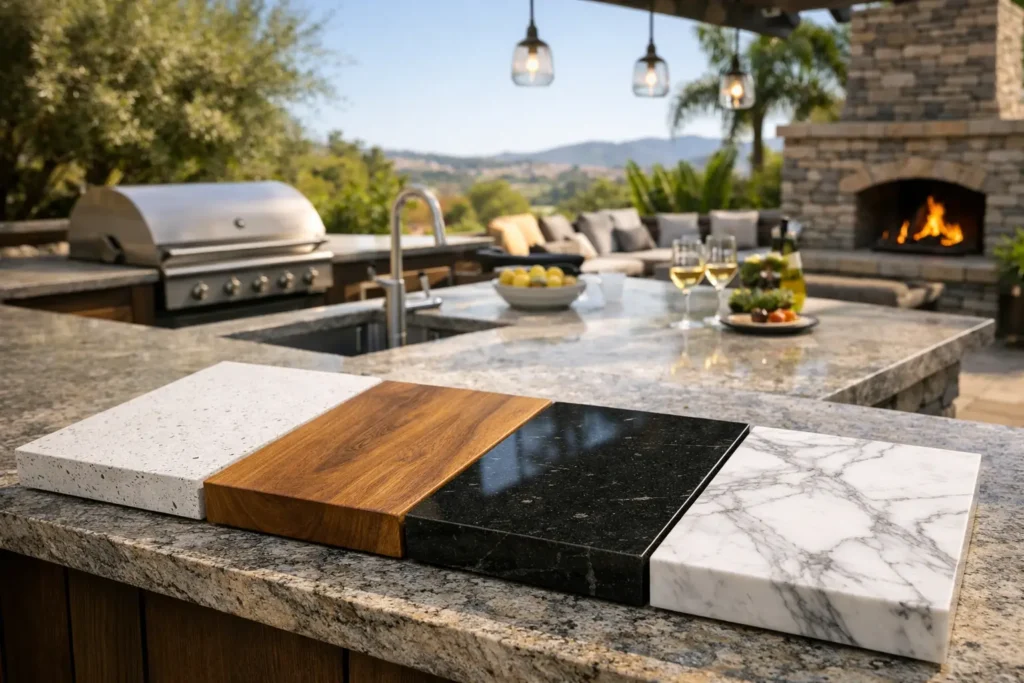
A beautiful outdoor kitchen can lose its polish quickly when the countertop stains after one dinner party, fades under relentless sun, or cracks through a season of temperature swings. The best outdoor counter materials are not simply the ones that look impressive on installation day. They are the surfaces that support the way you actually live outside – serving cocktails beside the pool, setting down hot platters, prepping pizza night, and welcoming a full table of guests without asking everyone to be careful.
For a high-end outdoor environment, the right counter should feel like a natural extension of the architecture, patio, and landscape around it. It also has to perform in the specific climate where it will live. Sunbelt homeowners contend with intense UV exposure, summer heat, sudden storms, humidity, and outdoor cooking. Those conditions narrow the field in useful ways.
What Makes an Outdoor Countertop Worth the Investment?
An outdoor countertop is a working surface and a visual anchor. It often spans the grill island, bar seating, beverage station, pizza oven surround, or poolside serving area. Because it occupies so much visual space, its color, edge profile, and finish can either elevate the entire design or make it feel pieced together.
Performance matters just as much. A good material should resist ultraviolet fading, moisture intrusion, food stains, heat, and everyday abrasion. But there is no universal winner. A covered pavilion kitchen has different needs than a fully exposed poolside bar, and a family that hosts weekly may prioritize low maintenance differently than homeowners who love the patina of natural stone.
The best decisions begin with the complete setting: sun exposure, roof coverage, cabinet construction, cooking appliances, surrounding hardscape, and the amount of care you want to give the space over time.
The Best Outdoor Counter Materials for a Custom Kitchen
Granite: The Proven Natural-Stone Choice
Granite remains a favorite for luxury outdoor kitchens because it brings depth, movement, and individuality that manufactured surfaces cannot fully duplicate. Each slab has its own mineral pattern, allowing a counter to become a statement piece rather than a neutral utility surface.
It also performs well outdoors when the right slab and finish are selected. Dense granite is naturally heat resistant and stands up well to the demands of grilling and entertaining. Darker granites are often especially forgiving around cooking areas, while leathered or honed finishes can create a more relaxed, architectural look than high polish.
The trade-off is maintenance. Granite should be professionally sealed, then resealed as needed to maintain strong stain and moisture resistance. Some lighter or more porous varieties require more attention than others. With thoughtful material selection and proper fabrication, however, granite delivers the enduring, custom feel many homeowners want at the center of an outdoor gathering space.
Quartzite: Dramatic Beauty With Outdoor Strength
For homeowners drawn to the light, veined look often associated with marble, quartzite can be an exceptional option. This natural stone offers striking visual movement and is generally harder and more durable than marble, making it better suited to busy outdoor kitchens.
Quartzite can bring a refined, resort-inspired character to a bar or island, particularly when paired with warm wood tones, textured stone veneer, or clean-lined stucco. It is a compelling choice for a covered kitchen where the counter will be highly visible from the pool, patio, or main living area.
Not every quartzite slab performs the same way, so it pays to assess the specific material rather than relying on its name alone. Some stones are more porous and may need regular sealing. A designer and fabricator can help identify slabs with the density, finish, and coloration appropriate for your climate and placement.
Porcelain Slabs: Sleek, Low-Maintenance Performance
Large-format porcelain has become a standout option for contemporary outdoor kitchens. It is engineered to resist UV exposure, staining, moisture, and heat, and it requires virtually no sealing. That makes porcelain especially appealing for fully exposed kitchens, bright pool decks, and homeowners who want a refined surface without a long maintenance list.
Porcelain also offers remarkable design flexibility. It can mimic limestone, marble, concrete, metal, or richly veined stone while maintaining consistent color from one installation to the next. A soft limestone-look porcelain can connect an outdoor kitchen to a pale travertine-style patio, while a darker concrete finish can complement a modern fire feature or black-framed pavilion.
Its limitation is in fabrication, not day-to-day use. Porcelain requires experienced cutting, edge detailing, and installation because the material is thinner than many natural stone slabs and can chip if handled incorrectly. The finished result depends heavily on craftsmanship. When expertly detailed, it creates crisp, elegant lines that suit a tailored backyard design.
Sintered Stone: Premium Engineering for Exposed Spaces
Sintered stone is another high-performance surface made under intense heat and pressure to create a dense, durable slab. Like porcelain, it offers impressive resistance to UV rays, stains, scratches, and thermal change. It is particularly well suited to outdoor counters that receive full sun and frequent use.
The appeal is both practical and aesthetic. Sintered stone is available in sophisticated finishes that range from quiet solid colors to convincing natural-stone visuals. For homeowners who want a pale, clean counter near a grill or swim-up bar but do not want to worry about routine sealing, it can be a smart premium investment.
Cost and fabrication availability can be higher than more familiar options. Still, for a custom outdoor kitchen intended to look polished year after year, its stability and minimal upkeep often justify the investment.
Concrete: Sculptural and Fully Custom
Concrete brings a different kind of luxury: one shaped specifically for the site. It can be cast in nearly any size, color, thickness, or profile, which makes it ideal for sweeping waterfall edges, curved bars, integrated dining ledges, and one-of-a-kind kitchen islands.
Its visual character works beautifully in modern, desert-inspired, industrial, and Mediterranean-influenced backyards. Pigments, aggregates, hand-troweled textures, and custom edge details make each installation personal. Concrete can also coordinate naturally with retaining walls, fireplaces, and architectural hardscape elements.
It does require realistic expectations. Concrete is sealed for protection, but it can develop fine hairline cracks and gain character over time. Some homeowners see that evolution as part of its appeal; others prefer a more uniform surface. Regular resealing and a skilled installer are essential, especially in areas exposed to intense sun or repeated moisture.
Materials That Need Extra Caution Outdoors
A material may be beautiful indoors without being a practical choice for an exposed kitchen. Marble, for example, is timeless but can etch, stain, and weather quickly around citrus, wine, grease, and outdoor cooking. It can work in a shaded, lightly used serving area for homeowners who embrace patina, but it is rarely the easiest choice for a hardworking grill island.
Engineered quartz is another material that deserves caution. Despite its popularity inside the home, many quartz products are not recommended for direct outdoor use. Prolonged UV exposure and heat can cause fading, discoloration, or warping, depending on the product. Always confirm the manufacturer’s outdoor warranty before considering it.
Tile can be cost-effective and visually versatile, but grout lines introduce more cleaning and maintenance. It is best used intentionally, perhaps on a backsplash or accent surface, rather than as the main counter in a luxury kitchen expected to host often.
Match the Countertop to the Way You Entertain
The right choice becomes clearer when you picture a typical evening in your backyard. If your kitchen is fully exposed beside a pool, porcelain or sintered stone offers peace of mind under direct sun, splashes, and constant use. If you want the warmth and distinction of a natural material beneath a covered pavilion, granite or carefully selected quartzite can create an inviting focal point.
Think beyond the counter alone. A pale surface can brighten a shaded kitchen but may show grill residue more readily. A heavily patterned stone can disguise everyday messes but compete with busy pavers or a dramatic backsplash. A leathered finish softens glare and hides fingerprints, while a polished finish reflects light beautifully in a protected setting.
Edge details matter, too. A substantial mitered edge communicates a more architectural, furniture-like presence. A simple eased edge is clean and contemporary. At a bar, enough overhang for comfortable seating is every bit as important as the slab selection. These decisions shape how guests gather, not just how the kitchen photographs.
Let the Entire Backyard Guide the Material Choice
The most memorable outdoor kitchens do not look selected from a showroom wall. They feel composed for the home, the landscape, and the people who will use them. Your countertop should connect visually to the patio underfoot, frame the grill and appliances gracefully, and hold its own beside features such as a pool, fireplace, pergola, or pizza oven.
A cohesive plan also prevents expensive afterthoughts. Counter slab dimensions, support requirements, appliance cutouts, drainage, shade structures, and outdoor lighting all influence one another. Designing them together makes it possible to create a kitchen that feels effortless from every angle.
Choose the surface that fits your climate and maintenance preferences, then let thoughtful craftsmanship carry it into a backyard built for long meals, easy celebrations, and the kind of hospitality that makes guests linger.