A great backyard sport court does more than give kids a place to burn energy. It changes how your home feels on a Friday night, where guests gather during a party, and how often your family steps outside without being asked. The best backyard sport court ideas are not just about fitting in a hoop or net. They are about creating a space that looks intentional, plays beautifully, and belongs with the rest of your outdoor living design.
That distinction matters. In a high-end backyard, a sport court should feel like part of the estate, not an afterthought poured behind the house. When the layout, materials, lighting, landscaping, and adjacent gathering areas are handled with care, a court becomes one more reason your backyard feels complete.
What makes backyard sport court ideas worth considering?
For many homeowners, the answer starts with versatility. A court gives your backyard a built-in activity zone that works for children, teens, adults, and guests. Unlike a single-purpose feature, it earns its footprint day after day. Morning basketball practice, afternoon pickleball, evening shooting games under the lights – it keeps the space active in a way few upgrades can.
There is also a design advantage. A well-planned court can anchor one side of the property, balance larger elements like a pool or pavilion, and help organize circulation across the yard. On larger homesites, it adds structure. On tighter lots, it can be scaled and shaped to deliver recreation without overwhelming the landscape.
Of course, the right idea depends on how you actually live. Some families want serious game play. Others want casual recreation wrapped in a polished resort-style setting. The smartest projects begin there, with lifestyle first and surface dimensions second.
11 backyard sport court ideas for a more dynamic outdoor space
1. A multi-sport court for the family that wants options
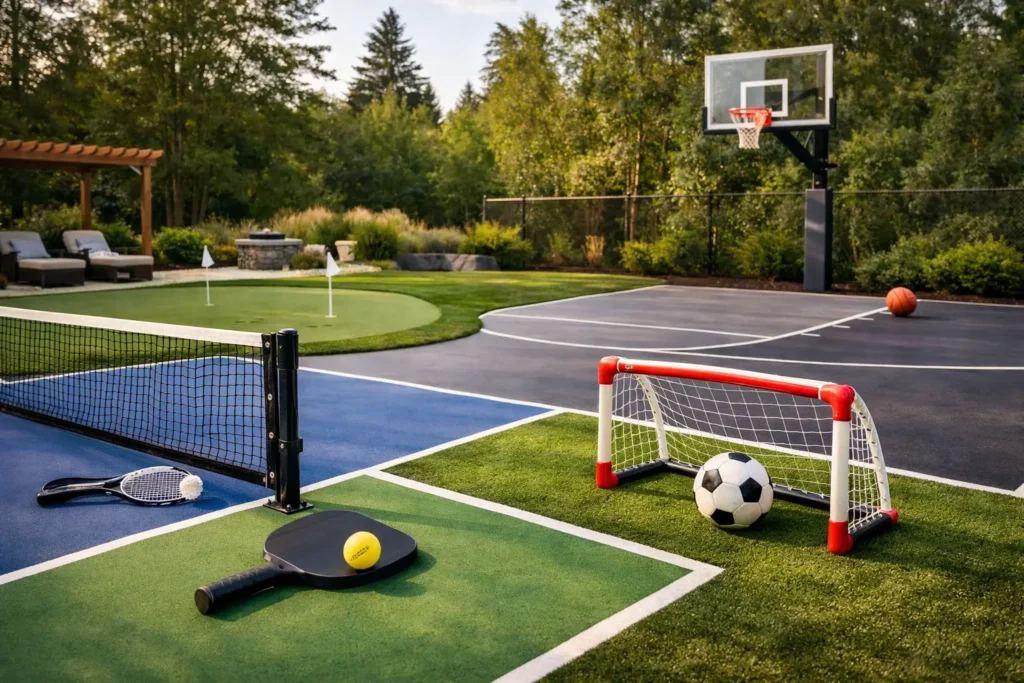
If your household plays a little of everything, a multi-sport court is often the strongest choice. Basketball, pickleball, volleyball, and casual fitness drills can all happen in the same footprint when striping and equipment are planned correctly.
This is often the best answer for families with children of different ages or homeowners who entertain often. The trade-off is that a multi-use layout may not feel regulation-perfect for every sport. But for many households, flexibility matters more than exact dimensions.
2. A pickleball-focused court with room to lounge nearby
Pickleball has become one of the most requested backyard recreation features for good reason. It is social, approachable, and genuinely fun for a wide range of ages. A private court also changes how often people play because there is no scheduling, no waiting, and no drive.
What elevates this idea is what happens around the court. Add a shaded seating area, low landscape lighting, and a nearby beverage station or outdoor kitchen, and the experience becomes bigger than the game. It starts to feel like an outdoor club designed around your home.
3. A half basketball court with premium lighting
A half court is one of the most practical backyard sport court ideas for homeowners who want strong day-to-day use without dedicating the space a full court requires. It supports shooting practice, one-on-one games, and casual play while leaving room for other amenities.
Lighting makes a major difference here. Evening play extends the value of the court, but fixtures need to be placed carefully so they support visibility without creating glare across the yard. In luxury outdoor environments, performance matters, but visual calm matters too.
4. A compact court designed for smaller lots
Not every property calls for a large athletic footprint. A compact court can still deliver plenty of function when dimensions are tailored to the site. This might mean a shorter basketball key, a reduced pickleball practice zone, or a flexible hardscape area designed for skill work and casual games.
The key is resisting the urge to force oversized features into undersized space. A compact court that is beautifully integrated will always feel better than a cramped one that dominates the yard.
5. A court framed by lush landscaping
One of the simplest ways to elevate a sport court is to soften its edges. Layered planting beds, ornamental trees, privacy hedges, and stone borders help the court feel embedded in the landscape rather than dropped onto it.
This approach is especially valuable for homeowners who want recreational space without sacrificing beauty. Planting also helps with screening, sound absorption, and transitions between active and quiet zones. In the right setting, the court still performs like a sport surface, but visually it becomes part of a refined garden environment.
6. A sports court beside the pool and patio
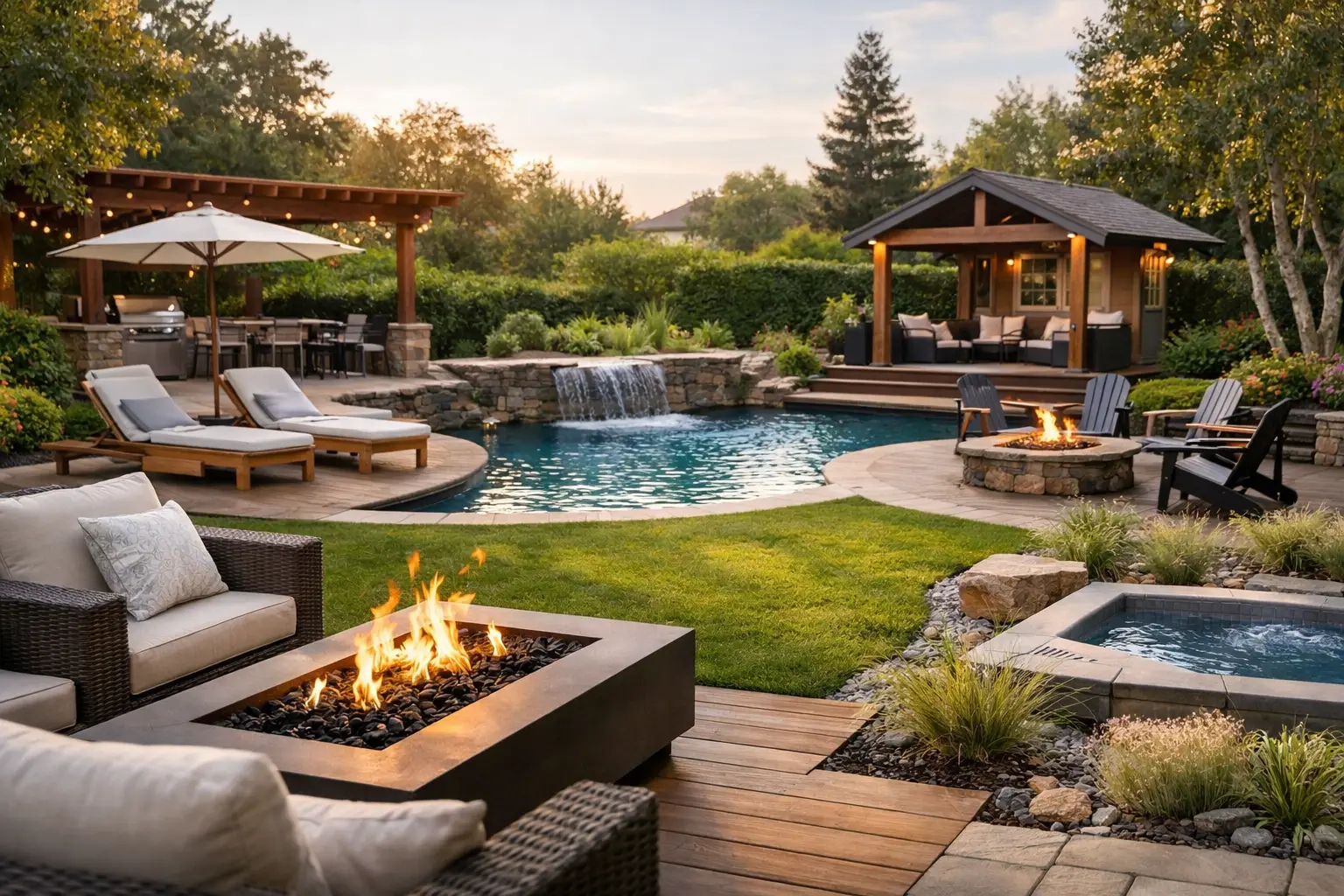
When a court sits near the pool, outdoor kitchen, or covered lounge, the entire backyard becomes more social. Some guests can swim, others can play, and everyone remains part of the same atmosphere. That kind of layout works especially well for families who host often and want the backyard to feel alive.
This idea takes thoughtful planning. You need enough separation to keep the court safe and functional, but enough visual connection that it still feels tied to the rest of the design. Done well, it turns the backyard into a true entertainment destination.
7. A custom-color court that complements the home
Standard sport surfaces do the job, but custom colors bring a more finished look. Rich greens, slate blues, charcoal tones, and carefully selected accent striping can echo the home’s architecture, pool finishes, or hardscape palette.
This may seem like a small detail, yet it has a major impact on the final result. In a premium backyard, color selection is part of the design language. It helps the court feel custom-built instead of off-the-shelf.
8. A court with integrated fencing that looks intentional
Fencing is often necessary, particularly for basketball and pickleball, but it should not feel industrial. Sleek black fencing, strategic heights, landscape screening, and thoughtful placement can maintain function without making the space look harsh.
This is where craftsmanship shows. The best projects treat containment as a design element, not a problem to hide. That means cleaner lines, better materials, and transitions that respect the style of the home.
9. A shaded spectator zone for guests and grandparents
Not everyone wants to play, but many people want to be part of the action. Adding a pergola, pavilion, or covered seating area near the court creates a place to relax while still enjoying the energy of the game.
This is one of the most overlooked ideas, and one of the most valuable. It turns the court from a simple activity surface into a gathering place. It also makes the feature feel more gracious and hospitality-driven, especially during parties and family weekends.
10. A practice wall for solo play and training
For households with serious athletes, a practice wall can add another layer of usefulness. It works for tennis drills, soccer touches, agility routines, and rebound training, depending on the design.
It is not the right fit for every property, and it does require careful placement to avoid noise concerns. But when athletic development is a priority, it can turn the backyard into a much more effective training environment.
11. A court that converts into event space
Some homeowners want recreation, but they also want flexibility for larger gatherings. A cleanly designed court can double as overflow entertaining space during parties, fundraisers, or family celebrations. With quality surfacing and a strong layout, it can handle temporary seating, cocktail tables, or event activities when not in active use.
This idea works best when the court is visually polished and connected to the rest of the backyard. It is another reminder that function and elegance do not have to compete.
How to choose the right backyard sport court idea
The right answer usually comes down to four things: available space, primary sport, visual priorities, and how social the backyard needs to be. If basketball is the clear favorite, build around that. If the court is for entertaining, think beyond the playing surface and focus on seating, lighting, and proximity to other features.
Budget matters too, but not just in the obvious way. A smaller, beautifully integrated court often creates more long-term satisfaction than a larger court with minimal design attention. The same is true for materials, drainage planning, and base construction. The parts you do not notice right away often determine how well the court performs over time.
It also helps to think about noise, privacy, and sun exposure before finalizing the location. Afternoon shade can make summer play more comfortable. Strategic screening can preserve a peaceful atmosphere. And proper placement can keep the active energy of the court from interrupting quieter spaces like a fire pit or spa retreat.
Why design matters as much as playability
A sport court is easy to add. It is much harder to integrate beautifully. That is why the strongest projects are designed as part of the entire outdoor environment, not treated as a separate installation.
When the court aligns with the home, connects naturally to patios and walkways, and reflects the same level of craftsmanship as the rest of the property, it becomes more than a place to play. It becomes part of your lifestyle story. For homeowners investing in a full backyard transformation, that difference is everything.
At Beyond Backyard Living, that is often where the most exciting possibilities begin – not with a single feature, but with a complete vision for how the backyard should look, feel, and bring people together.
The best court is not the biggest one or the trendiest one. It is the one that fits your property so well that it feels like it was always meant to be there.