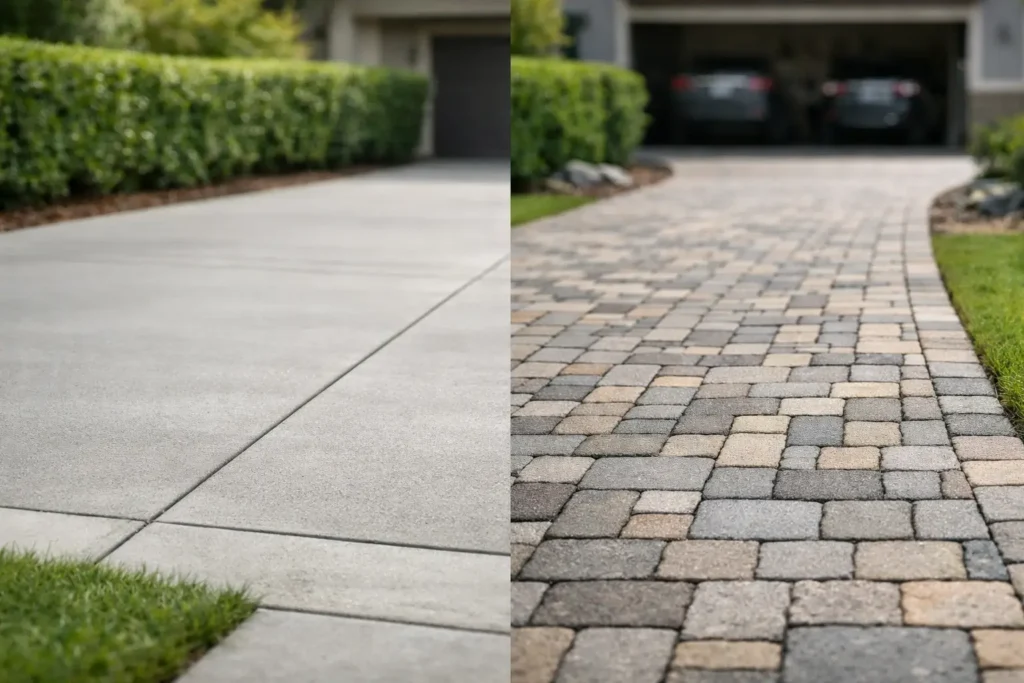
The driveway sets the tone before anyone reaches your front door. It frames the home, shapes first impressions, and quietly signals whether the property feels ordinary or thoughtfully designed. That is why the concrete vs paver driveway decision matters more than many homeowners expect. This is not just a materials question. It is a design choice that affects curb appeal, maintenance, long-term value, and how polished your home feels every time you pull in.
For some homes, poured concrete is the right answer. For others, pavers create the richer, more tailored finish that makes the entire exterior feel elevated. The best choice depends on your priorities, your architecture, and how you want the space to perform over time.
Concrete vs Paver Driveway: The Core Difference
A concrete driveway is a continuous slab poured in place. It offers a clean, streamlined surface and can be finished in several ways, from basic broom texture to decorative stamping or coloring. The appeal is simplicity. Concrete tends to look neat, classic, and understated.
A paver driveway is built from individual units, typically made of concrete, brick, or natural stone, set over a prepared base. The look is more dimensional and architectural from the start. Pavers allow for patterns, borders, color variation, and a custom finish that feels intentional rather than standard.
In practical terms, concrete usually starts with a lower upfront price, while pavers offer more design flexibility and easier repairability. In aesthetic terms, the difference can be dramatic. One reads as functional and clean. The other often feels custom and estate-like.
Curb Appeal and Design Impact
If visual impact is high on your list, pavers have a clear advantage. A paver driveway can echo the tones of your home, complement surrounding hardscapes, and create a more cohesive arrival experience. This matters even more if you are already investing in a larger outdoor transformation with walkways, entry steps, retaining walls, or a front courtyard.
Pavers tend to look more at home in luxury settings because they bring texture, pattern, and craftsmanship into a part of the property that often gets treated as purely utilitarian. Instead of reading like a slab in front of the garage, the driveway becomes part of the overall design language.
Concrete can still be attractive, especially on modern or minimalist homes where a clean plane suits the architecture. Decorative concrete has come a long way, and a well-executed finish can be a strong fit when the goal is restraint. The trade-off is that even enhanced concrete usually has a more uniform appearance. It rarely delivers the same depth or tailored character as a thoughtfully designed paver installation.
Which material looks more premium?
In most cases, pavers create the more upscale result. They feel crafted rather than poured. That difference is hard to miss, particularly on larger driveways or homes with strong architectural presence.
That said, premium is not just about spending more. It is about choosing a finish that fits the home. A sleek contemporary property may benefit from refined concrete more than a traditional tumbled paver. Good design always starts with context.
Durability in Real-World Conditions
Both materials can serve well for years, but they age differently.
Concrete is strong, but it is vulnerable to cracking. Soil movement, temperature swings, tree roots, and heavy vehicle loads can all contribute. Even with proper control joints, cracking is a common part of concrete ownership. Sometimes those cracks stay minor. Sometimes they become visually distracting or structurally problematic.
Pavers perform differently because they are made of many interlocking pieces. This gives the surface a degree of flexibility. When the base is installed correctly, pavers can better accommodate minor ground movement without creating the same kind of obvious, continuous cracks you see in slabs.
That does not mean pavers are maintenance-free or indestructible. Individual units can shift, settle, or loosen if the base preparation is poor or if drainage is not handled correctly. The difference is that problems are often more manageable because they are localized.
For homeowners in the Sunbelt, heat is another factor. Both surfaces absorb warmth, but some concrete finishes can show discoloration or wear over time under intense sun exposure. Pavers generally hold visual variation more gracefully, which helps them continue looking polished even as the years pass.
Maintenance and Repairs
This is where the conversation often becomes more practical.
Concrete is fairly simple day to day. It should be cleaned periodically and sealed when appropriate, especially if it has decorative finishes. The challenge comes when damage appears. A crack or stained section is not easy to blend away. Patching often stands out. Replacing a section can leave noticeable color differences between old and new concrete.
Pavers require their own care. Joint sand may need replenishing, weeds can appear if maintenance is neglected, and sealing may be recommended depending on the product and finish. But when repairs are needed, individual pavers can usually be removed and replaced without rebuilding the entire driveway. That is a meaningful advantage for long-term ownership.
Concrete vs paver driveway maintenance over time
If your goal is the lowest possible initial maintenance, concrete may seem appealing. If your goal is preserving a beautiful surface over many years with easier spot repairs, pavers often come out ahead.
This is especially true on high-visibility homes where appearance matters as much as function. A driveway that can be refreshed piece by piece is often easier to keep looking exceptional.
Cost: Upfront vs Long-Term Value
There is no way around it. Pavers usually cost more upfront than standard concrete. The material itself is more design-oriented, and installation is more labor-intensive. Base preparation, edge restraints, bedding layers, pattern work, and finishing all require precision.
Concrete tends to be more budget-friendly at the start, which makes it attractive for homeowners focused on immediate cost control. If you need a large driveway and want a straightforward solution, concrete may offer the best entry point.
But upfront cost is only part of the value conversation. A driveway is a major visual surface on your property. If pavers improve curb appeal, complement the architecture, and reduce the impact of future repairs, they may offer stronger value over time, especially in neighborhoods where design quality influences perceived home value.
For luxury-minded homeowners, the better question is often not Which one costs less? It is Which one supports the level of finish I want for this home?
Lifestyle, Entertaining, and the Bigger Picture
Driveways do more than handle cars. They shape arrival. They frame holiday gatherings, welcome guests, and influence how the entire front elevation is experienced. If your property includes a custom front walk, upgraded entry, landscape lighting, or a connected outdoor living environment, the driveway should not feel like an afterthought.
Pavers shine in homes where every exterior detail is being considered as part of a cohesive vision. They can mirror patio materials, tie into garden walls, or create a grander sense of arrival that feels aligned with the rest of the property.
Concrete works well when the broader design calls for simplicity, or when the driveway is one upgrade among many and visual continuity can be achieved in other ways. It can absolutely be part of a polished exterior. It just offers fewer opportunities for artistry.
This is often where a design-build perspective changes the decision. Instead of evaluating the driveway in isolation, it helps to see how it contributes to the full outdoor experience. That is where a custom approach can create something that feels composed, not pieced together.
So Which Should You Choose?
Choose concrete if you want a clean, cost-conscious driveway with a simpler installation and a look that suits modern, understated architecture. It can be an excellent fit when budget is a major factor or when the design intent is minimal and refined.
Choose pavers if you want a more custom, elevated finish with stronger design flexibility and easier long-term repair options. For homeowners creating a high-end exterior with lasting visual impact, pavers often deliver the more impressive result.
The right answer depends on how you weigh cost, style, maintenance, and the overall vision for your home. A driveway is not just pavement. It is part of the welcome, part of the architecture, and part of the lifestyle your property creates.
If you are planning improvements beyond the driveway, it is worth thinking bigger. The best exterior spaces feel unified from the curb to the backyard. When the materials, layout, and craftsmanship all work together, the result is more than an upgrade. It feels like coming home to a place designed for the way you want to live.