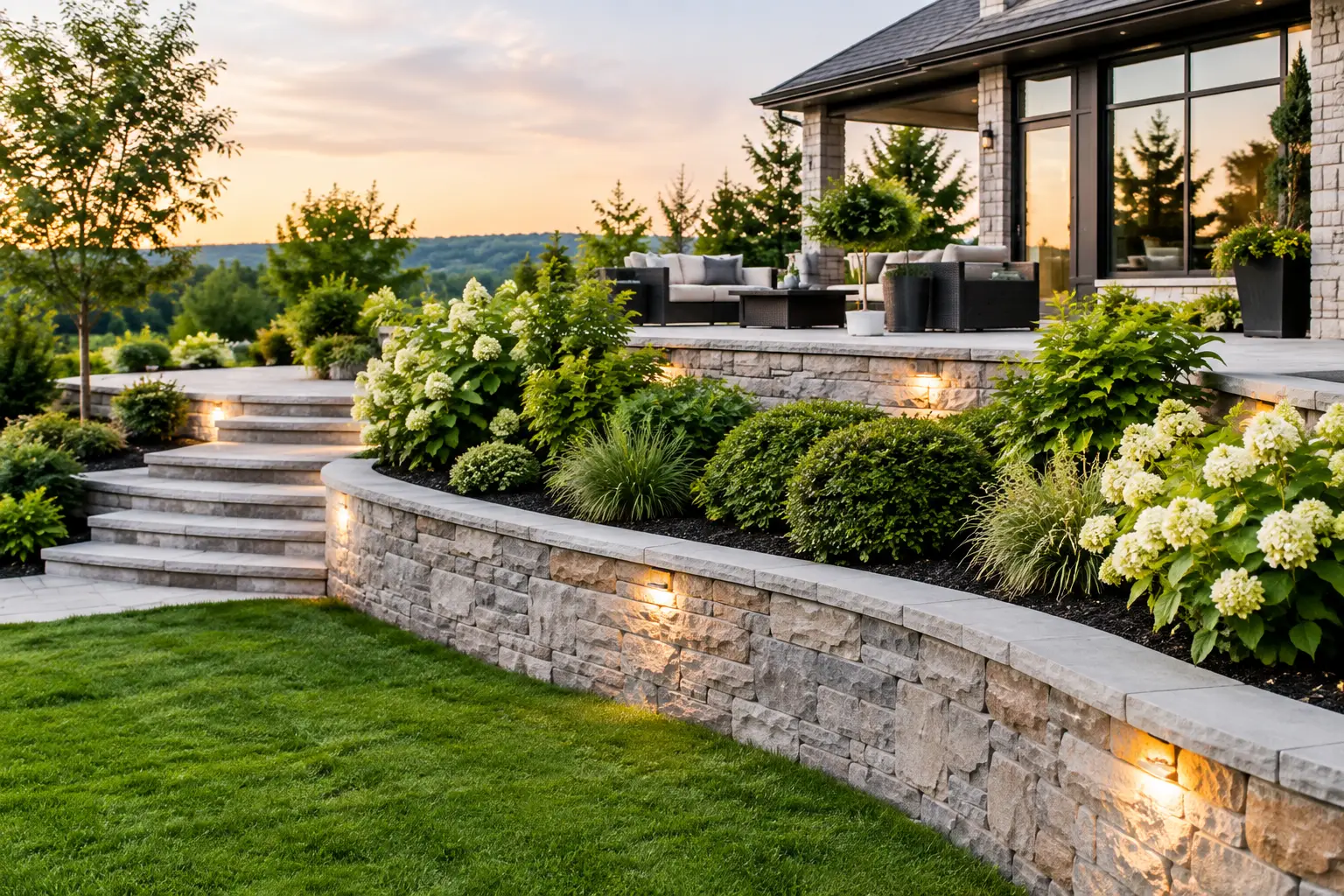
A sloped backyard does not have to be a limitation. With the right retaining wall design ideas, a challenging grade can become the feature that gives an outdoor space its character: a series of garden terraces, a secluded fire lounge, a poolside overlook, or a gracious path that leads guests through the landscape.
For a high-end backyard, a retaining wall should never feel like an afterthought built simply to hold back soil. It is an architectural element. Its material, height, placement, lighting, and relationship to patios, water, and planting all influence how the property looks and how it lives.
Start With the Experience, Not the Wall
The most successful retaining walls begin with a larger question: how do you want to use the space? A wall that supports a dining terrace needs a different presence than one that frames a quiet garden walk. A pool deck may call for clean, contemporary lines, while a naturalistic waterfall setting may look best with weathered stone and layered planting.
This approach keeps the project cohesive. Rather than placing a wall where the grade demands one and decorating around it later, the wall becomes part of a complete composition. It can direct movement, create privacy, establish distinct outdoor rooms, and make previously unusable portions of the yard feel intentional.
1. Create Terraced Levels for a Resort-Style Backyard
Terracing is one of the most transformative retaining wall design ideas for a sloped property. Instead of fighting a steep grade with one imposing wall, several lower walls can create a sequence of usable levels. One terrace might hold a pool and sun shelf, another an outdoor kitchen and dining area, and a third a lawn for play or a tucked-away fire feature.
Lower walls are often more inviting visually, especially when softened with planting. They also give a large backyard more rhythm. Guests can move from one experience to the next rather than gathering on a single flat expanse.
The trade-off is that terracing requires thoughtful circulation. Wide stairs, landings, and pathways should feel natural underfoot and generous enough for entertaining. In a premium setting, the route between levels deserves as much design attention as the terraces themselves.
2. Extend Patio Materials Into the Wall
Material continuity is one of the simplest ways to make hardscape feel custom. If a patio is finished in warm-toned natural stone, a retaining wall using complementary stone can make the entire setting feel grounded and composed. For a more tailored contemporary look, smooth architectural block, large-format porcelain, or clean-cut stone veneer can echo the home’s exterior.
Matching every surface exactly is not always the goal. Too much repetition can feel flat. A better approach is to coordinate color temperature, texture, and scale. A light limestone patio, for example, may pair beautifully with a wall in slightly deeper, textured stone capped in the same family of tones.
Coping matters here. A substantial cap can give a wall a finished, furniture-like quality, especially where guests may sit with a drink or where the wall edges a patio. The cap should be comfortable, durable, and proportioned to the wall beneath it.
3. Build Seating Into the Retaining Wall
A seat wall is one of the most useful ways to turn necessary structure into hospitality. Around a fire pit, it provides extra seating without crowding the patio with chairs. Along a dining terrace, it creates a relaxed edge where guests can linger. Near a pool, it can offer a place to set towels, watch children, or take in the view.
Seat walls work best at a comfortable sitting height and with a broad, smooth cap. Their placement should support conversation rather than leave people facing away from the action. In an outdoor lounge, a curved wall can gently gather people around a fire feature. A straight wall can create a crisp boundary between a patio and planted slope.
4. Frame a Water Feature With Natural Stone
Retaining walls and water features are natural partners. The change in elevation that calls for a wall can also create an opportunity for a cascading waterfall, a reflecting basin, or a poolside water wall. Stone retaining walls are especially effective in this setting because they can make the water feel as though it has always belonged on the property.
The key is restraint. A waterfall should sound and look appropriate for its location. A bold, energetic cascade can energize a poolscape, while a quieter spillway may better suit a courtyard retreat. Plumbing access, splash zones, and long-term maintenance need to be resolved before construction, not hidden beneath beautiful stone after the fact.
5. Use Planting Pockets to Soften Structure
A retaining wall gains depth when it is designed with the landscape rather than placed in front of it. Planting pockets at the base, between terraces, or above the wall can soften masonry and connect the structure to the garden. In warm climates, ornamental grasses, flowering perennials, sculptural evergreens, and draping groundcovers can create a layered, established appearance.
Plant selection depends on sun exposure, irrigation, and how formal the landscape should feel. A sharply modern wall may need a restrained palette with repeated forms. A more organic garden wall can support a richer mix of texture and seasonal color.
Avoid the temptation to plant too densely on day one. A luxury landscape needs room to mature. Proper spacing lets individual plants develop their intended shape and prevents a carefully built wall from disappearing behind overgrowth.
6. Add Lighting That Makes the Grade Feel Intentional
After sunset, retaining walls can either disappear into darkness or become some of the most compelling features in the yard. Integrated lighting under coping, subtle step lights, and carefully placed uplighting can reveal stone texture, guide guests safely between levels, and create a warm sense of depth.
Lighting should support the atmosphere, not compete with it. Bright fixtures aimed directly across a patio can feel more like security lighting than a relaxed evening setting. Softer layers of light work better: enough illumination for steps and transitions, enough glow to define gathering areas, and enough shadow to preserve a sense of retreat.
7. Define an Outdoor Kitchen or Dining Terrace
A retaining wall can give an outdoor kitchen the architectural backdrop it needs. It may hold a raised planting bed behind the grill station, frame a dining area, or create a transition from the cooking zone to a lower lounge. In a larger backyard, this separation helps each space feel purposeful without making the overall design feel fragmented.
Consider sightlines while planning the wall. The cook should be able to stay connected to guests, and diners should have a pleasing view rather than face a blank expanse of masonry. A low wall with planting, a water feature, or a view beyond it can create definition without closing in the space.
8. Make a Pool Wall Do More Than Retain Soil
Around a pool, a retaining wall can become a dramatic focal point. It may support a raised spa, incorporate sheer descents, create privacy from a neighboring property, or provide a backdrop for loungers. In contemporary designs, a clean linear wall can give the pool area a crisp resort character. In more traditional settings, hand-selected stone can establish warmth and permanence.
Pool walls require particularly careful coordination. Drainage, waterproofing, pool equipment, elevation changes, and finish materials all need to work together. This is where a unified design-build approach protects the vision. A wall, pool, patio, and planting plan designed separately can create awkward transitions and unnecessary compromises.
9. Turn a Front-Yard Slope Into Curb Appeal
Retaining walls are not only for backyards. A front-yard wall can establish a refined arrival experience, create a level lawn, frame an entry walk, or manage a sloped driveway edge. The best front-yard walls complement the architecture of the home and feel scaled to the street.
Because these walls are highly visible, materials and craftsmanship matter. Thoughtful curves, substantial caps, layered planting, and discreet lighting can make an elevation change feel like a signature feature rather than a practical correction.
10. Prioritize Engineering and Drainage From the Beginning
Beauty depends on performance. Retaining walls hold significant pressure, particularly after heavy rain, and poor drainage is one of the most common causes of failure. Depending on wall height, soil conditions, local codes, and the load above or below the wall, engineered plans and permits may be required.
A properly built wall typically includes a prepared base, appropriate reinforcement, drainage stone, collection systems, and a controlled way for water to exit. These details are largely invisible when the project is complete, but they determine whether the finished wall remains stable and beautiful for years.
The most memorable outdoor spaces make every change in elevation feel like an invitation. Whether your property needs a quiet garden terrace or a complete multi-level entertaining retreat, begin with a plan that treats the retaining wall as part of the experience. With thoughtful design and exacting craftsmanship, the slope in your yard can become the reason everyone wants to gather there.