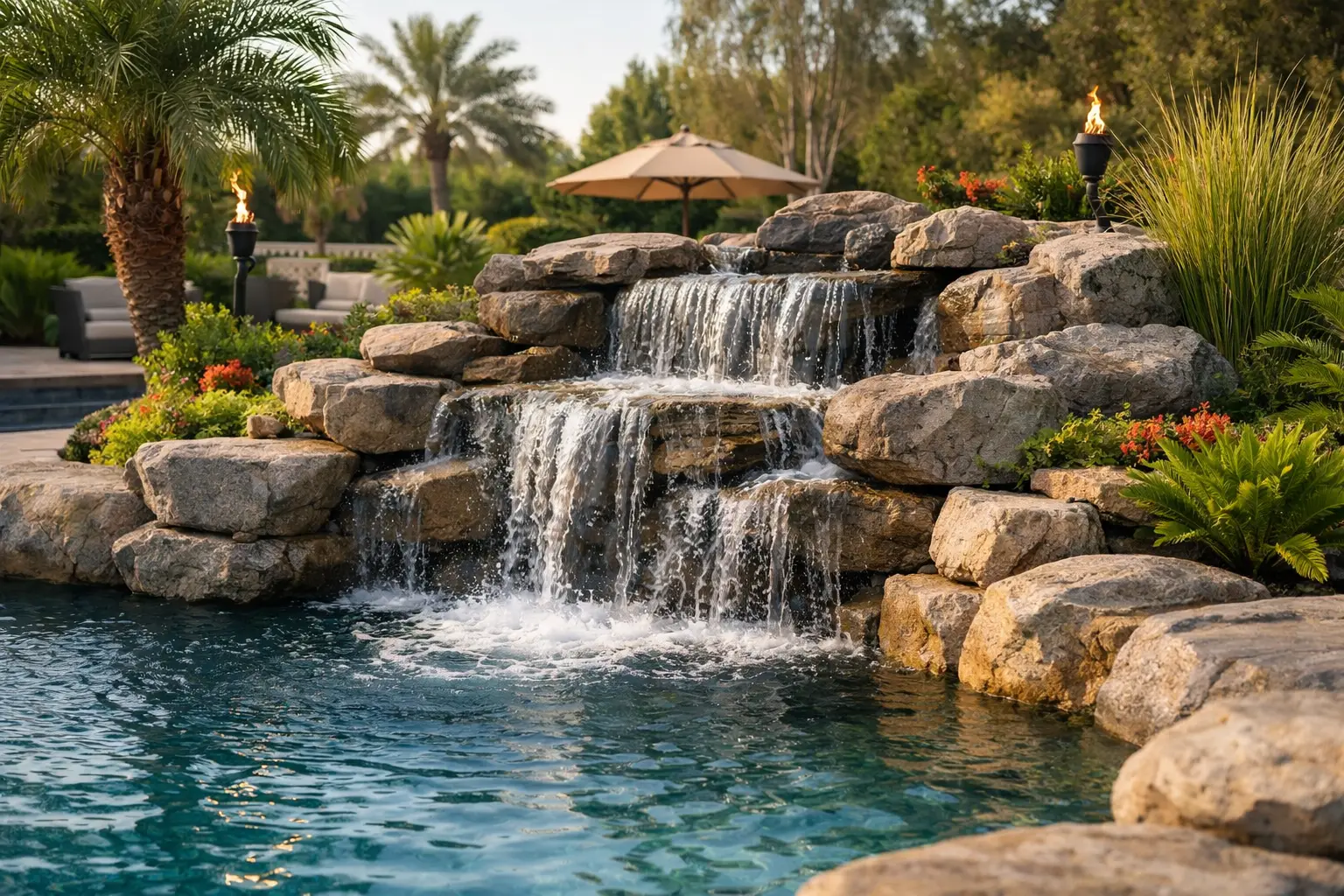
The moment water begins to move across natural stone, a backyard feels different. The air seems cooler, surrounding sounds soften, and the view from the patio gains a living focal point. A custom waterfall installation is not simply a landscape feature. It is an opportunity to shape the atmosphere of the entire outdoor environment – from peaceful morning coffee to lively evenings spent hosting friends and family.
For a high-end backyard, the difference is in the planning. A waterfall should feel as though it belongs to the property, whether it spills into a pool, disappears into a hidden reservoir, or anchors a garden retreat. Its scale, sound, stone selection, lighting, and relationship to the home all matter. When those details work together, the result feels less like an add-on and more like a destination built into your landscape.
What a Waterfall Installation Can Do for Your Backyard
Water brings movement to spaces that can otherwise feel still and overly structured. It softens the geometry of a pool deck, patio, retaining wall, or outdoor kitchen while giving the eye somewhere intentional to land. In a larger outdoor living plan, a waterfall can also create a natural transition between activity zones and quieter areas of the yard.
The sound is often just as valuable as the view. A carefully designed cascade can help blur traffic noise, nearby conversations, or the hum of neighborhood activity. That does not mean every homeowner needs a loud, dramatic rush of water. Some prefer a gentle sheet flowing over a clean stone edge, while others want the layered sound of multiple falls moving through boulders and planting beds. The right approach depends on how close the feature sits to your seating area, bedrooms, property line, and pool.
A waterfall also gives a backyard a stronger sense of permanence. Natural stone, architectural masonry, and custom lighting create depth that annual flowers alone cannot provide. It becomes a feature your guests remember, especially when it is integrated with the places where people naturally gather.
Start With the Experience, Not the Stone
Homeowners often begin by selecting a favorite waterfall image. Inspiration is useful, but a successful design starts with a more personal question: how do you want to use the space around it?
If your backyard is designed for entertaining, the waterfall may become a backdrop for a lounge area, fire feature, or outdoor dining space. A pool waterfall can add visual drama from the house while still preserving generous deck space for chaises and guests. In a more private garden setting, a pondless waterfall may create a tucked-away retreat beside a pergola or quiet seating wall.
Consider where the feature will be seen most often. The view from the kitchen, family room, primary suite, and main patio should guide its placement. A beautiful water feature hidden behind a pool cabana or positioned where it is rarely viewed will not deliver the same daily enjoyment. Sightlines deserve as much attention as the waterfall itself.
The experience also determines the scale. A modest spillway can be elegant beside a compact patio. On an expansive property, a small waterfall can disappear visually and sonically. Larger multi-tiered falls, substantial boulders, and layered plantings may be needed to give the feature the presence it deserves.
Pool Waterfalls and Pondless Waterfalls
A pool waterfall is a natural choice for homeowners creating a resort-style destination. It can be built into a raised spa wall, a rock grotto, a retaining wall, or an architectural feature with smooth, modern lines. Because the pool already serves as the water basin, the design can feel especially cohesive when the waterfall materials relate to the coping, decking, and surrounding hardscape.
Pondless waterfalls are ideal when the goal is the sight and sound of water without an open pond. Water circulates through a concealed underground reservoir, making this option appealing for households with young children, pet owners, or homeowners who want a lower-profile garden feature. A pondless design can still be substantial, with multiple drops, natural stone, planting pockets, and accent lighting. It simply returns water out of sight at the base.
Neither option is automatically better. A pool waterfall supports a larger backyard statement and pairs naturally with swimming, sun shelves, and spa experiences. A pondless waterfall offers flexibility and can fit beautifully into side gardens, entry landscapes, slopes, or intimate courtyards where a pool is not part of the plan.
The Design Details That Make Water Feel Natural
The most convincing waterfall installation rarely looks perfectly symmetrical. In nature, water finds varied paths, catches on stone edges, and changes pace as it moves downward. Custom design uses that principle without sacrificing control, safety, or quality construction.
Stone selection carries much of the visual weight. Large, well-placed boulders can create a rugged, natural character, while cut stone and masonry can produce a more refined architectural expression. The best choice should connect with the home. A contemporary residence may call for linear spillways and crisp stone faces. A more traditional or rustic property may feel right with irregular boulders, textured coping, and layered cascades.
Water volume is equally important. Too little flow can make a feature look underwhelming, particularly when broad stones or multiple drops are involved. Too much flow can create unwanted splash, excessive noise, and a higher operating cost. Pump sizing, plumbing layout, elevation changes, and spillway dimensions should all be engineered around the desired effect rather than guessed during construction.
Lighting extends the value of the feature beyond daylight hours. Underwater lighting can reveal the movement of water, while discreet landscape fixtures can highlight stone texture and nearby plantings. Warm lighting tends to create an inviting atmosphere for entertaining. The goal is not to make every rock visible, but to create depth and a sense of discovery after sunset.
Construction Matters Beneath the Surface
The visible stonework is only one part of a lasting water feature. Beneath it are the components that determine whether it performs beautifully year after year: properly prepared base materials, waterproofing, plumbing, pumps, filtration where needed, valves, electrical connections, drainage, and access for future service.
This is why a water feature should be planned early in a larger outdoor project. If a waterfall will connect to a new pool, retaining wall, patio, or outdoor kitchen, the infrastructure needs to be coordinated before hardscape surfaces are finished. Designing it as part of the whole prevents awkward transitions, unnecessary demolition, and the look of a feature placed wherever space happened to remain.
Drainage deserves special attention in Sunbelt landscapes, where intense rain can arrive quickly. The feature and its surrounding grades must direct stormwater appropriately, protect nearby structures, and keep the landscape from becoming saturated. A professional design also accounts for equipment access and the practical realities of maintenance without allowing pumps, valves, or panels to interrupt the view.
At Beyond Backyard Living, that full-project perspective is central to creating outdoor environments that feel composed from every angle. Water, hardscape, planting, architecture, and gathering spaces should support one vision rather than compete for attention.
Plan for Care Without Letting It Limit the Design
Every waterfall requires some level of care, but maintenance does not have to feel burdensome. The requirements depend on the feature type, local conditions, water chemistry, surrounding trees, and how often it runs. Pool waterfalls are usually maintained as part of pool care. Pondless systems may need periodic debris removal, pump inspection, and attention to the reservoir.
Thoughtful design makes care easier. Accessible equipment, properly sized skimmers or intake bays, quality pumps, and planting choices that limit heavy leaf drop can make a noticeable difference. Homeowners should also decide whether they want the waterfall operating continuously or on a scheduled cycle. Timers and automation can help balance ambiance with energy use.
There are trade-offs to consider. Broad, dramatic falls often create more splash and evaporation than a controlled sheer descent. Dense greenery around a naturalistic waterfall looks lush, but it may introduce more seasonal debris. These are not reasons to avoid a bold design. They are reasons to build with clear expectations and the right systems in place.
Give the Feature Room to Become a Destination
A waterfall is most compelling when it has room to breathe. Avoid crowding it with too many unrelated finishes, ornaments, or competing focal points. Instead, frame it with purposeful planting, a comfortable place to sit, and material transitions that make sense throughout the yard.
Imagine the final setting after sunset: water catching the light, a fire feature glowing nearby, dinner being served from the outdoor kitchen, and guests lingering longer because the backyard feels more like a private retreat than a patio behind the house. That is the value of a waterfall designed as part of a larger lifestyle experience.
If you are considering a water feature, begin with the view you want to create from inside your home and the moments you want to host outside. Those answers will lead to a waterfall that does more than circulate water – it gives your backyard a lasting sense of place.